

A cavitation machine is an aesthetic body-contouring device that delivers ultrasound energy through a handpiece placed against the skin. Cavitation may be the machine’s only function or one module in a larger system that also includes radiofrequency, vacuum, or light-based technologies. It is used for localized cosmetic contouring—not for treating obesity or producing general weight loss.
This guide is for people researching a treatment as well as beauty professionals comparing equipment. It explains what an ultrasonic cavitation machine does, what “40K” means, how cavitation differs from the other technologies often built into the same cabinet, and why results and safety depend on the specific device and procedure.
Key takeaways
- Cavitation is the ultrasound function, not every function included in a multifunction machine.
- “40K” means 40 kHz, or 40,000 cycles per second. It is a frequency specification, not an effectiveness score.
- Body contouring is different from weight loss.
- Device instructions, operator training, individual suitability, and local regulations all matter.
Table of Contents
- What is a cavitation machine?
- How does an ultrasonic cavitation machine work?
- What technologies can be built into one machine?
- What does 40K mean?
- What is the machine used for?
- Professional vs. home machines
- Results and limitations
- Safety and risks
- Machine evaluation checklist
- Frequently asked questions
What Is a Cavitation Machine?
The term usually refers to an aesthetic device with an ultrasound handpiece designed for non-invasive body-contouring procedures. The handpiece is placed against the skin with a coupling medium such as ultrasound gel; no incision is involved.
The machine may be a compact, single-technology unit. It may also be a multifunction system with several handpieces that look similar but deliver different types of energy or mechanical action. That distinction matters: the presence of RF, vacuum, or laser pads does not turn those functions into “cavitation.”
Searchers also use terms such as ultrasonic cavitation machine, fat cavitation machine, and body cavitation machine. These can describe the same broad category, but intended use and regulatory status must be checked for each model and market. The U.S. Food and Drug Administration also distinguishes contouring a localized area from treating obesity or producing general weight loss. (FDA: Non-Invasive Body Contouring Technologies)
How Does an Ultrasonic Cavitation Machine Work?
Ultrasound energy and acoustic cavitation
Ultrasound is sound energy at frequencies above the upper limit of human hearing. A machine converts electrical input into mechanical vibration at the transducer inside its handpiece. When the handpiece is coupled to the skin, ultrasound energy can enter the underlying tissue.
In broad physical terms, acoustic cavitation involves small gas or vapor cavities forming and behaving under changing acoustic pressure. Frequency alone does not determine the biological effect; output, waveform, exposure, applicator design, tissue, and technique also matter.
Evidence for one ultrasound platform therefore cannot prove the performance of every salon machine. Reviews cover different device types and protocols, including focused and nonfocused technologies; they provide context, not interchangeable product certification. (PubMed: Ultrasound for Aesthetic Applications—Mechanisms and Safety)
Why contact and coupling gel matter
Coupling gel helps remove the air gap and maintain contact as the handpiece moves. The FDA notes that therapeutic ultrasound requires complete skin contact and that gel helps ensure contact and reduce burn risk. The correct medium and procedure must come from the exact device instructions.
What cannot be assumed
A product label such as “40K cavitation” does not, by itself, establish how much energy reaches a target, which body areas are suitable, how many procedures are appropriate, or what result a person will achieve. Those questions require the complete technical documentation, intended-use information, and professional assessment—not just a frequency printed in a product title.
What Technologies Can Be Built Into a Cavitation Machine?
Many professional systems place several functions in one cabinet. They may share a screen and power supply, but not the same physical mechanism.
| Module | Input | General role in a multifunction system | Important distinction |
|---|---|---|---|
| Ultrasonic cavitation | Ultrasound energy | The core cavitation function | It is not RF, vacuum, or laser treatment |
| Radiofrequency | RF energy and controlled heating | A separate function included in some body and facial systems | Multipolar RF is not automatically RET/CET |
| Vacuum | Negative pressure and mechanical action | A separate module, sometimes combined with bipolar RF | A vacuum handpiece should not be called a roller unless it has a verified mechanical roller |
| Diode laser or low-level light pads | Light energy | A separate light-based module | Laser and LED versions are not interchangeable terms |
This matters when reading “5-in-1,” “6-in-1,” or “9-in-1” names. There is no universal counting rule, so compare the module list rather than assuming two machines with the same function count are equivalent.
Equipment example: Farslim FR-601S
The confirmed base FR-601S 6-in-1 cavitation machine uses a 7-inch screen, 1 cavitation handpiece rated at 40 kHz, 1 vacuum bipolar RF handpiece, 3 multipolar RF handpieces, and 8 diode lipo laser pads—6 large and 2 small. This illustrates module separation; not every machine has these functions.
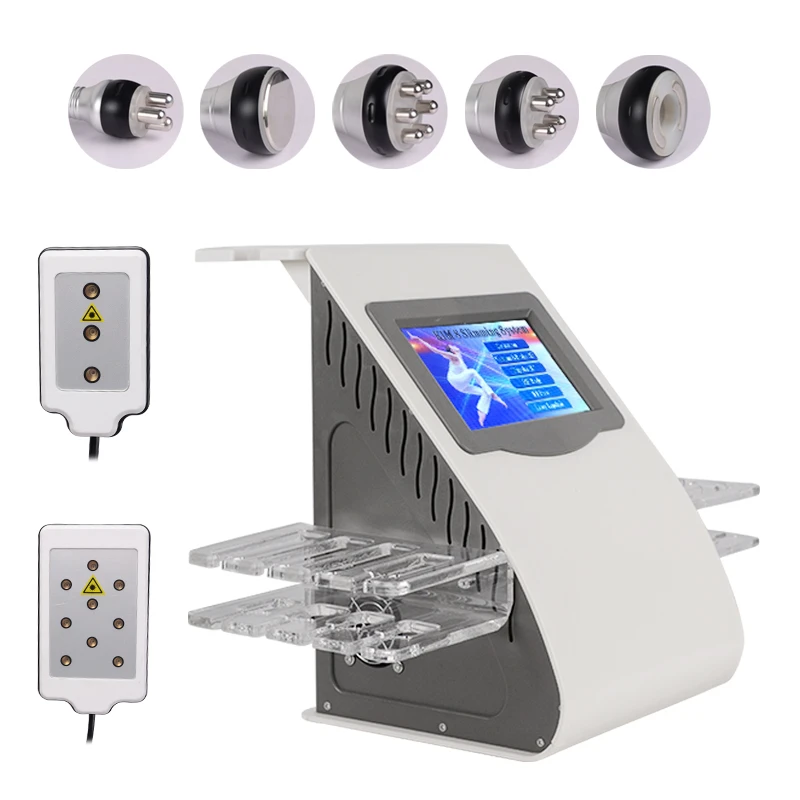
The base model is not a cryolipolysis, magnetic-sculpting, or RET/CET system. Separate FR-601S variants include a vertical version and an enhanced version with an ice hammer and EMS-enabled laser pads.
What Does “40K” Mean on a Cavitation Machine?
On a cavitation machine, 40K normally means 40 kHz. A kilohertz is 1,000 cycles per second, so 40 kHz equals 40,000 cycles per second. The label identifies a nominal operating frequency for the ultrasound function.

It is not a performance rating: a higher or lower frequency is not automatically better, deeper, safer, or more effective. Two 40K machines may still differ in transducer design, output, controls, duty cycle, and quality assurance.
Treat frequency as one line in the specification sheet. Also examine the handpiece, adjustable parameters, intended use, safety documentation, manual, service support, and model-specific conformity or authorization records.
What Is a Cavitation Machine Used For?
Cavitation machines are commonly positioned for localized cosmetic contouring in salons, beauty centers, and aesthetic practices. Ultrasound may be one part of a broader service, depending on the device and its intended use.
Localized contouring is not the same as changing a person’s overall body weight. The FDA states that non-invasive body contouring does not treat obesity or deliver the health benefits of weight loss. Results may also be temporary, may vary between people, and may require more than one procedure.
Universal lists of “approved treatment areas” can mislead. Suitable areas depend on device labeling, applicator, training, health history, and local rules; a product description cannot replace the instructions or a suitability assessment.
For comparison, fat freezing vs. cavitation explains two non-interchangeable methods: controlled cooling versus sound energy.
Professional vs. Home Cavitation Machines
“Professional” and “home” labels are not enough to compare devices. Read the specifications and instructions.
| Question to compare | Professional equipment | Home-use equipment |
|---|---|---|
| Intended user and setting | Should specify the trained operator and professional environment | Should expressly state that it is intended for consumer/home use |
| Handpieces | May include several applicators or technologies | May use one fixed or limited set of applicators |
| Controls | May offer more adjustable parameters or stored programs | May use presets or simplified controls |
| Operating duty | Must be checked for repeated business use | Must be checked for the stated personal-use pattern |
| Documentation | Operator manual, warnings, technical specifications, and training information | Consumer instructions, warnings, and clear usage limits |
| Serviceability | Replaceable handpieces, cables, consumables, and technical support may be important | Warranty and replacement policy still need verification |
| Regulatory status | Must match the model, intended use, and destination market | Consumer sale does not automatically prove authorization for every claimed use |
These are comparison questions, not universal differences. Do not assume that a home device is a reduced-power professional unit or that a large cabinet is safer unless documentation supports it.
Commercial buyers can compare modules across professional cavitation machines or see how a 5-in-1 40K cavitation RF vacuum machine is organized. Product pages compare specifications; they do not provide treatment advice.
What Results and Limitations Should You Expect?
Ultrasound body-contouring research reports outcomes for specific devices, parameters, populations, and measurement periods—not one guaranteed result for every cavitation machine.
A dermatology review identified research on ultrasound for body contouring, skin tightening, and cellulite, but it combined multiple ultrasound applications and study designs. An updated review of non-invasive body-contouring technologies likewise covers a broad set of modalities rather than validating every commercial product. (PubMed: Review of Ultrasound in Body Contouring; PubMed: Updated Narrative Review of Non-Invasive Body Contouring)
When evaluating a claim, ask:
- Which device, ultrasound technology, settings, and schedule were studied?
- How many participants completed the study, and what outcome was measured?
- When was the measurement taken, and how long did follow-up continue?
Do not convert an average study result into a promise for an unrelated 40K machine. Before-and-after photos also need consistent conditions and disclosure of other interventions.
Safety, Risks, and Who Should Seek Professional Advice
Non-invasive does not mean risk-free. The FDA lists pain or discomfort, redness, swelling, bruising, and palpable nodules among complications reported across body-contouring technologies. For therapeutic ultrasound specifically, it lists possible redness, swelling, blisters, burns, discomfort, and nerve damage.
The FDA also advises against ultrasound procedures for people with open wounds or lesions, compromised skin, active implanted devices, or metal beneath the skin. Medical history, medication, prior procedures, and the intended area can add other considerations.
Safety note: This section summarizes general FDA consumer guidance and does not provide medical advice or an individual treatment protocol. Readers should use the instructions for the exact device and consult an appropriately qualified professional about personal suitability.
Operators should follow the specified handpiece, gel, settings, cleaning, and consumables. If a machine malfunctions, stop and follow the manufacturer’s service process. Farslim owners can start with the cavitation machine repair and support hub.
How to Evaluate a Cavitation Machine
Use this checklist before comparing prices or feature counts:
- Confirm the frequency and handpiece.Find the actual ultrasound specification for the exact model.
- Separate the modules.List cavitation, RF, vacuum, and light/laser functions individually.
- Check intended use and market status.Verify the exact model and destination country rather than relying on a logo alone.
- Read the manual.Review operating limits, warnings, contraindications, cleaning, and maintenance.
- Assess training needs.Confirm who may operate the equipment under local rules and what training is supplied.
- Check parts and consumables.Ask about handpieces, cables, gel, pads, fuses, and other replaceable items.
- Review after-sales support.Compare warranty terms, technical response, spare-parts access, and service procedures.
A CE document may support conformity within its stated scope; it does not prove a clinical result. Its model list, manufacturer, standards, report reference, date, and scope must match the claim.
Frequently Asked Questions
What does a cavitation machine do?
A cavitation machine delivers ultrasound energy through a handpiece placed against the skin for localized body-contouring procedures. Some machines provide only cavitation, while multifunction systems may also include RF, vacuum, or light-based modules. The intended use and expected outcome must be checked for the exact model rather than assumed from the category name.
Is a cavitation machine the same as radiofrequency?
No. Cavitation uses ultrasound energy, while radiofrequency equipment delivers RF energy that can heat tissue. Manufacturers often install both functions in one cabinet, which is why they are easily confused. They require separate handpieces, operating parameters, precautions, and evidence; one function should not be used as proof for the other.
What does 40K mean on a cavitation machine?
“40K” normally means that the ultrasound function operates at a nominal frequency of 40 kHz, equal to 40,000 cycles per second. It is one technical specification, not a score for quality, depth, safety, or results. The full device design, output controls, documentation, and intended use must also be evaluated.
Do cavitation machines cause weight loss?
They should not be presented as weight-loss machines. The FDA distinguishes non-invasive body contouring from treating obesity or producing the health benefits associated with weight loss. A device may be intended to change the appearance or circumference of a localized area, but individual responses vary and a cosmetic procedure does not replace weight management or medical care.
Are professional and home cavitation machines the same?
Not necessarily. They may differ in intended user, controls, handpieces, operating duty, documentation, serviceability, and regulatory status. However, “professional” and “home” are marketing labels unless supported by the specification and instructions. Compare the exact models and never assume that a home unit is simply a lower-power version of a salon machine.
Do cavitation machines work?
Research on ultrasound-based body contouring reports outcomes for particular devices and protocols, but those findings cannot be applied automatically to every machine carrying a cavitation or 40K label. Evaluate the exact technology, study design, measured outcome, follow-up period, device documentation, and individual suitability before forming an expectation.
What Is a Cavitation Machine? The Final Takeaway
A cavitation machine is an ultrasound-based body-contouring device, either used alone or integrated with separate technologies such as RF, vacuum, and light-based pads. Understanding that module separation is the first step toward reading a specification correctly. The next step is to verify the exact device, its intended use, documentation, operator requirements, risks, and evidence—without treating a frequency label or function count as a guaranteed result.
To see how those modules vary in real equipment, compare the specifications across Farslim’s professional cavitation machines.


